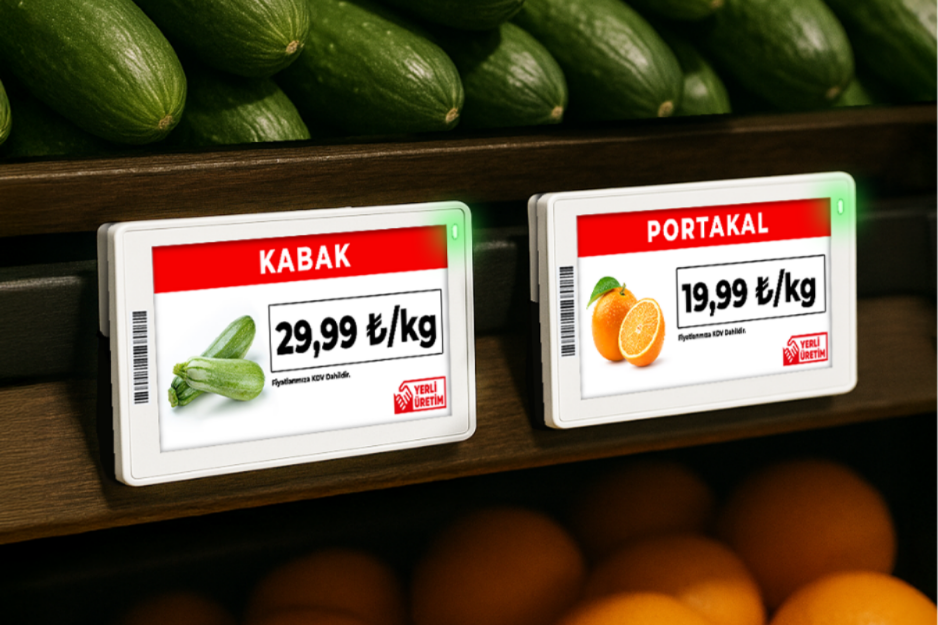
In the retail sector, price is no longer static information. In today's store environments, price is treated as live data that needs to be rapidly updated, applied flawlessly, and compatible with different channels. Electronic shelf labels represent not only the visible face of this transformation but also the underlying technological and operational changes.
In this context, electronic shelf labels should be considered not as a standalone hardware solution, but as a technological layer where data, processes, and in-store experience intersect.
Price accuracy is not just an operational issue in retail; it's directly related to customer trust and brand perception. Electronic shelf labels take this accuracy to a new level by enabling the synchronized management of price information with centralized systems.
The key difference here is the ability to control when, where, and to what extent price changes are applied. During campaign periods or in scenarios requiring rapid price updates, delays and errors caused by manual processes are eliminated. Thus, pricing ceases to be a scattered, in-store practice and becomes measurable and manageable data.
The impact of electronic shelf labels on retail operations is not limited to price accuracy. Manual label changes require significant labor and time, especially in large stores. Digital label infrastructure automates this process, reducing the operational burden.
This allows store teams to dedicate their time to areas of direct customer contact rather than repetitive tasks like price changes. Therefore, electronic shelf labels indirectly contribute to improved in-store service quality.
In-store shelves are the first point of contact for customers with products. Electronic shelf labels ensure that the information presented at this moment of contact is up-to-date and consistent. Clearly displayed price, unit information, and campaign details simplify the customer's decision-making process.
These labels provide continuous information on the shelves without using loud marketing language. This makes the store experience more organized and trustworthy. In this respect, digital shelves are positioned as a communication tool that directly addresses the customer without being intrusive.
As retail operations grow, consistently managing price and product information becomes increasingly challenging. Electronic shelf labels, with their scalable structure, make it possible to control this complexity.
Systems applicable at different scales, from single stores to multi-branch chains, support standardization thanks to their centralized management approach. When the number of stores increases or the product range expands, the inclusion of new labels into the system does not disrupt the existing structure. This flexibility offers a significant advantage in terms of long-term store investments.
Electronic shelf labels are not the final link in the digitalization of retail; rather, they lay the groundwork for more advanced store technologies. The digital structure on the shelves may become more integrated with data analytics, automation, and centralized decision-making systems in the future.
From this perspective, shelves become more than just areas where prices are displayed; they become touchpoints where retail strategies are reflected in the field and their impact is observed. In this transformation, electronic shelf labels stand out not just as a current operational need, but as a fundamental component of tomorrow's data-driven store concept.